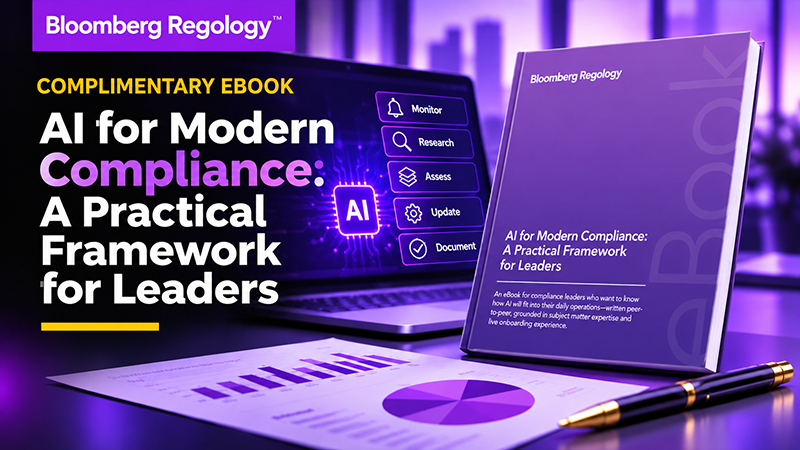
Regulatory compliance is getting more complex. AI is changing how organizations keep up.
Compliance teams are under increasing pressure to monitor evolving regulations, interpret new requirements, update internal policies, and demonstrate accountability, often with limited resources and outdated manual processes.
But what if much of that work could be completed in minutes instead of days?
Bloomberg Regology's complimentary eBook, AI for Modern Compliance: A Practical Framework for Leaders, explores how generative and agentic AI are transforming regulatory compliance workflows, from monitoring and research to policy management and audit preparation.
Drawing on real-world implementation experience and illustrative efficiency comparisons, this guide offers compliance leaders a framework for understanding how AI can support their teams while keeping human expertise and oversight at the center of critical decisions.
Inside the eBook, discover:
How AI is transforming regulatory change management, helping teams monitor evolving laws and identify relevant updates across jurisdictions.
Why regulatory research could take minutes instead of days, with illustrative workflows showing up to 120x faster research-to-policy processes.
How AI agents can reduce manual compliance workloads, automating repetitive research, analysis, and documentation tasks.
The five layers of AI-powered compliance, from intelligent regulatory monitoring and research to obligation mapping and policy gap analysis.
How automated policy updates and gap analysis work, helping organizations identify discrepancies and propose changes tied to regulatory requirements.
The role of human oversight in AI-driven compliance, including reviewing recommendations, validating decisions, and maintaining traceable audit records.
Discover what AI-powered regulatory compliance could mean for your organization.
Complete the form to access your complimentary copy of AI for Modern Compliance: A Practical Framework for Leaders and explore a more efficient approach to managing regulatory change.